What Is a Surfing Simulator?


Author
We work with clients and designers alike to create custom ride designs for greenfield projects, or ride additions to existing parks, helping them uncover their true entertainment potential.
Do you know what a surfing simulator is?
Surfing simulators—also known as flowboarding or indoor surfing—originated in the United States in 1991 as a way for people to safely experience the sensation of ocean surfing on land. Initially dubbed "Flowboarding," the activity evolved into what is now commonly called "board surfing" after skateboarding-style tricks were incorporated into the sport.
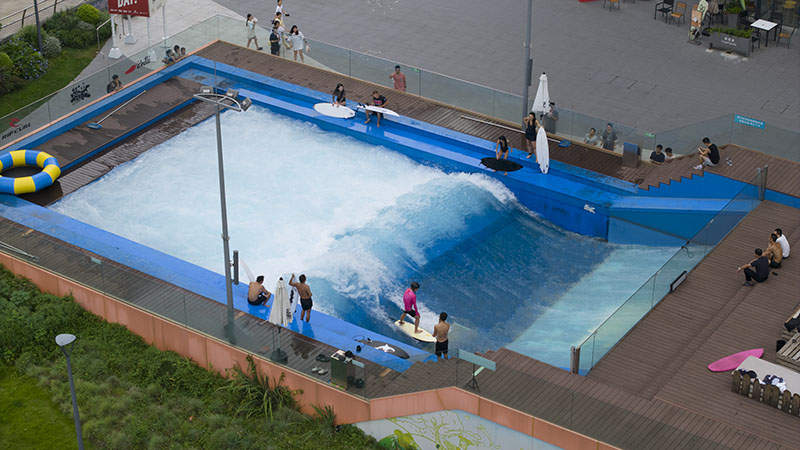
The system operates by forcing water through a specialized pressurization system and nozzles to create a thin, uniform sheet of water flowing rapidly upwards across the riding surface; riders glide downwards against this flow, simulating the experience of riding the face of a large wave. The equipment consists primarily of a stainless steel frame, a variable frequency drive, water pumps, and a specialized elastic membrane. Typical dimensions range from 12 to 18 meters in length, 6 to 10 meters in width, and 0.5 to 2.5 meters in height. The pumps discharge a water layer 3 to 5 inches thick at speeds ranging from 20 to 50 mph.
Surfing simulators generally fall into two categories: stationary and mobile.
Stationary units require excavation to install the equipment in a deep pit; this necessitates civil engineering work and a significant footprint. With a water capacity of approximately 150 tons and a design that makes removal difficult once installed, they are best suited for water parks and large-scale surfing facilities.
In contrast, mobile simulators do not require excavation or civil engineering work; they can be installed directly on flat ground with a relatively small footprint and a water capacity of around 30 tons. These are ideal for shopping malls, hotels, and smaller indoor surfing venues. Each type has its own advantages and disadvantages.